NovaAI Compute NovaAI Compute

Top AI Server Hardware Manufacturers for Global Buyers?

Time:2026-06-16 Author:Sienna
0%

As the demand for advanced computing power grows, selecting the right AI server hardware manufacturer becomes crucial for global buyers. Industry expert Dr. Sarah Lee, a leading researcher in AI infrastructure, noted, "The choice of hardware can make or break an AI project." This statement rings true as various manufacturers provide different capabilities that can significantly impact performance and efficiency.

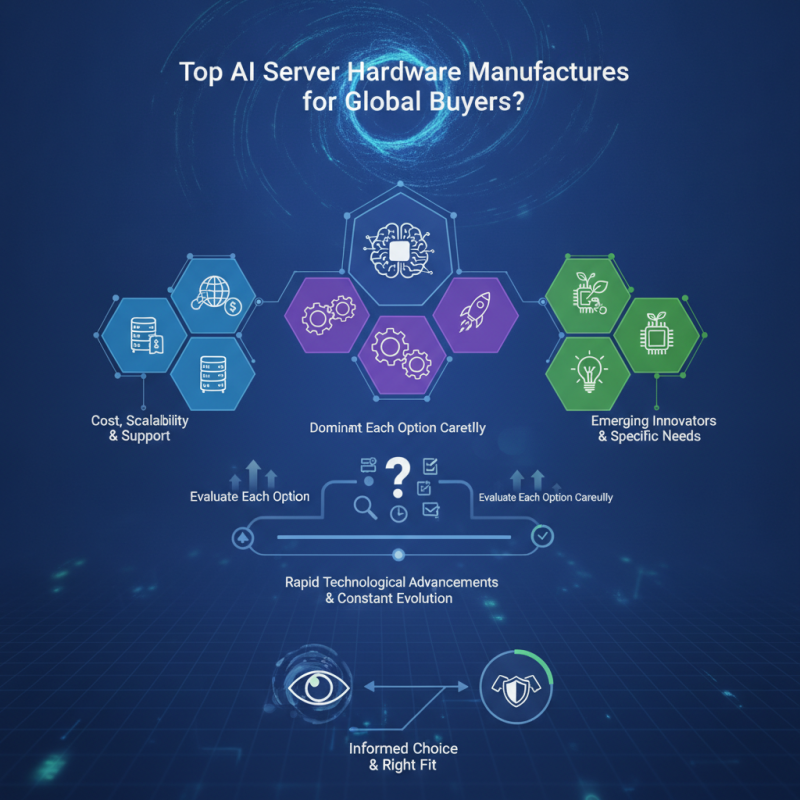
In today's competitive landscape, buyers must consider factors such as cost, scalability, and support. Some well-known manufacturers dominate the market, offering high-performance servers tailored for AI workloads. However, emerging players also bring innovative solutions that may suit specific needs better. The abundance of choices can lead to confusion, making it essential to evaluate each option carefully.

Additionally, the rapid pace of technological advancements means that even top manufacturers need to adapt quickly. This constant evolution creates uncertainty in selecting the best solutions. Buyers must stay informed about the latest trends to ensure they choose the right AI server hardware manufacturer for their unique requirements. A thoughtful approach is critical when navigating this complex market.
Top AI Server Hardware Manufacturers for Global Buyers?

Overview of the AI Server Hardware Market and Its Importance

The AI server hardware market has witnessed remarkable growth in recent years. This surge is driven by the increasing demand for powerful computing solutions. Businesses are now relying on advanced AI capabilities to enhance productivity and innovation. The significance of this market cannot be overstated; it plays a crucial role in supporting AI applications across various industries.

AI servers facilitate high-speed data processing and storage. These systems are designed to handle massive datasets efficiently. Organizations need to choose hardware that meets their specific requirements. The landscape is evolving rapidly, with companies often feeling the pressure to keep up with technological advancements.

However, not all manufacturers offer the same level of quality or reliability. Some products may not perform as expected in real-world scenarios, leading to potential setbacks. Understanding the intricacies of AI server hardware is essential for decision-making.

Organizations must weigh factors such as compatibility, performance, and scalability. While numerous options exist, selecting the right hardware requires careful consideration and trust in suppliers. Balancing cost and performance can be challenging.

The future of AI hardware hinges on ongoing research and development, addressing current limitations and exploring new capabilities.

Key Players in the AI Server Hardware Industry

The AI server hardware industry is evolving rapidly. Numerous manufacturers are stepping up to meet growing global demand. These players design systems that support extensive data processing and complex algorithms.

Key manufacturers focus on efficiency, performance, and scalability. Their products often feature advanced cooling systems and high-speed interconnects. However, challenges like supply chain disruptions can impact production timelines. Buyers must weigh performance against cost and availability.

Some manufacturers are pushing boundaries with innovations. They offer modular designs that allow easy upgrades. These changes can lead to better adaptability in a fast-paced market. Yet, selecting the right hardware requires careful consideration of specific needs and future growth. Each decision impacts overall system performance and longevity.

Top AI Server Hardware Manufacturers for Global Buyers

Manufacturer Market Share (%) Main Product Line Headquarters Founded Year
Company A 25 GPU Servers USA 2005
Company B 18 High-Performance Computing Germany 2010
Company C 15 Edge AI Servers China 2015
Company D 12 Data Center Solutions Japan 2000
Company E 10 AI Workstations South Korea 2018

Innovative Technologies in AI Server Hardware

The realm of AI server hardware is evolving rapidly. Cutting-edge technologies are transforming how data centers operate and enhance computational power. Specialized processors, such as neural processing units, are designed to accelerate machine learning tasks. These innovations enable faster data analysis and improved performance with lower energy consumption.

Another significant advancement is the integration of high-speed interconnect technologies. These ensure seamless communication between servers. Faster data transfer speeds reduce bottlenecks, enhancing workflow efficiency. Additionally, liquid cooling solutions are emerging as a practical method to manage heat in densely packed server environments. While traditional air cooling methods have limitations, liquid cooling can significantly enhance reliability and performance.

However, the AI hardware landscape is not without its challenges. The rapid pace of technological innovation can lead to premature obsolescence. Companies may invest heavily in new technologies only to find them outdated within a short period. This creates a dynamic yet uncertain market. Buyers must remain vigilant, continuously assessing their needs and the evolving landscape. Balancing cutting-edge features with long-term viability is essential for sustainable growth in AI applications.

Comparative Analysis of Leading AI Server Manufacturers

As the demand for AI processing power grows, the market for AI server hardware is expanding rapidly. Leading manufacturers ensure that their products support complex algorithms and large data sets. This competitive landscape drives innovation, but it can also lead to confusion for buyers. It's essential to know what each manufacturer offers in terms of performance and support.

When evaluating different manufacturers, consider the architecture of their hardware. Some focus on specialized chips designed for machine learning. Others may offer a balance between general-purpose processors and dedicated GPUs. This choice can significantly impact performance for specific AI applications.

Tip: Before purchasing, assess your specific requirements. Consider both current needs and future scalability.

Additionally, look for manufacturers with robust customer support. Reliable post-sale assistance can save time and resources later. A product is only as good as the backing it receives.

Tip: Research user reviews and competitive analysis reports. Real buyer experiences can provide valuable insights.

Choosing the right AI server manufacturer involves more than just specs. Understanding both the capabilities of the hardware and the quality of support is crucial. Engaging with experts or consulting firms can also offer clarity and direction.

Future Trends in AI Server Hardware Development

The landscape of AI server hardware is rapidly evolving. Advances in technology shape its future. One significant trend is the shift toward specialized hardware designed for deep learning. This includes custom processors and optimized architectures. These innovations enhance performance and energy efficiency. Increased data processing demands drive this specialization.

Another notable trend is the integration of edge computing. Deploying AI at the edge reduces latency and bandwidth usage. It allows for real-time data analysis. However, challenges remain in maintaining consistency across devices. Security concerns also increase as data moves closer to the source.

Sustainability becomes another focus. Manufacturers are exploring eco-friendly materials and energy-efficient designs. This change reflects the growing importance of environmental impact. Yet, balancing performance and sustainability is not straightforward. Buyers must assess these evolving factors when selecting AI server hardware.

FAQS

: What is driving the growth of the

I server hardware market?

Why is choosing the right AI server hardware important?

Choosing the right hardware is crucial for meeting specific requirements and ensuring efficient processing of massive datasets.

What should organizations consider when selecting AI server hardware?

Organizations should consider compatibility, performance, scalability, and support from manufacturers to make informed decisions.

What advancements are influencing the future of AI server hardware?

Specialized hardware for deep learning and edge computing are significant trends shaping the future of AI server development.

How does edge computing benefit AI applications?

Edge computing reduces latency and bandwidth usage, enabling real-time data analysis but presents challenges in consistency and security.

What challenges do organizations face when balancing cost and performance?

It can be difficult to find hardware that meets performance expectations without exceeding budget constraints, as quality varies greatly.

How can user reviews help in selecting AI server hardware?

User reviews provide insights into real-world performance and support quality, helping buyers make better choices.

Why is sustainability becoming a focus in AI hardware development?

There's a growing importance on environmental impact, pushing manufacturers to explore eco-friendly materials and energy-efficient designs.

What impact can unreliable hardware have on organizations?

Poor performance can lead to setbacks, wasted resources, and hindered productivity, making reliable hardware essential.

How should organizations prepare for future hardware developments?

Organizations must keep assessing emerging technologies and anticipate changing needs to ensure they stay competitive.

Conclusion

The AI server hardware market is rapidly evolving, driven by the increasing demand for advanced computational capabilities to support artificial intelligence applications. This growth emphasizes the importance of identifying capable AI server hardware manufacturers who can deliver cutting-edge technology and performance. Key players in the industry are focused on innovative technologies that enhance processing power, efficiency, and scalability, ensuring that they meet the diverse needs of global buyers.

A comparative analysis reveals that leading AI server hardware manufacturers are adopting progressive strategies to remain competitive. Future trends indicate a move towards more integrated and energy-efficient solutions, as well as the potential for greater customization to cater to specific industry requirements. As the market continues to expand, the role of these manufacturers will be crucial in shaping the future landscape of AI-related technologies.

Sienna

Sienna

Sienna is a skilled marketing professional with a deep expertise in our company’s core products and services. With a passion for innovation and detail, she plays a pivotal role in crafting insightful blog posts that not only highlight the unique features of our offerings but also provide valuable......